
The Careers We Don't Plan For: Lessons from Clean Energy Leaders
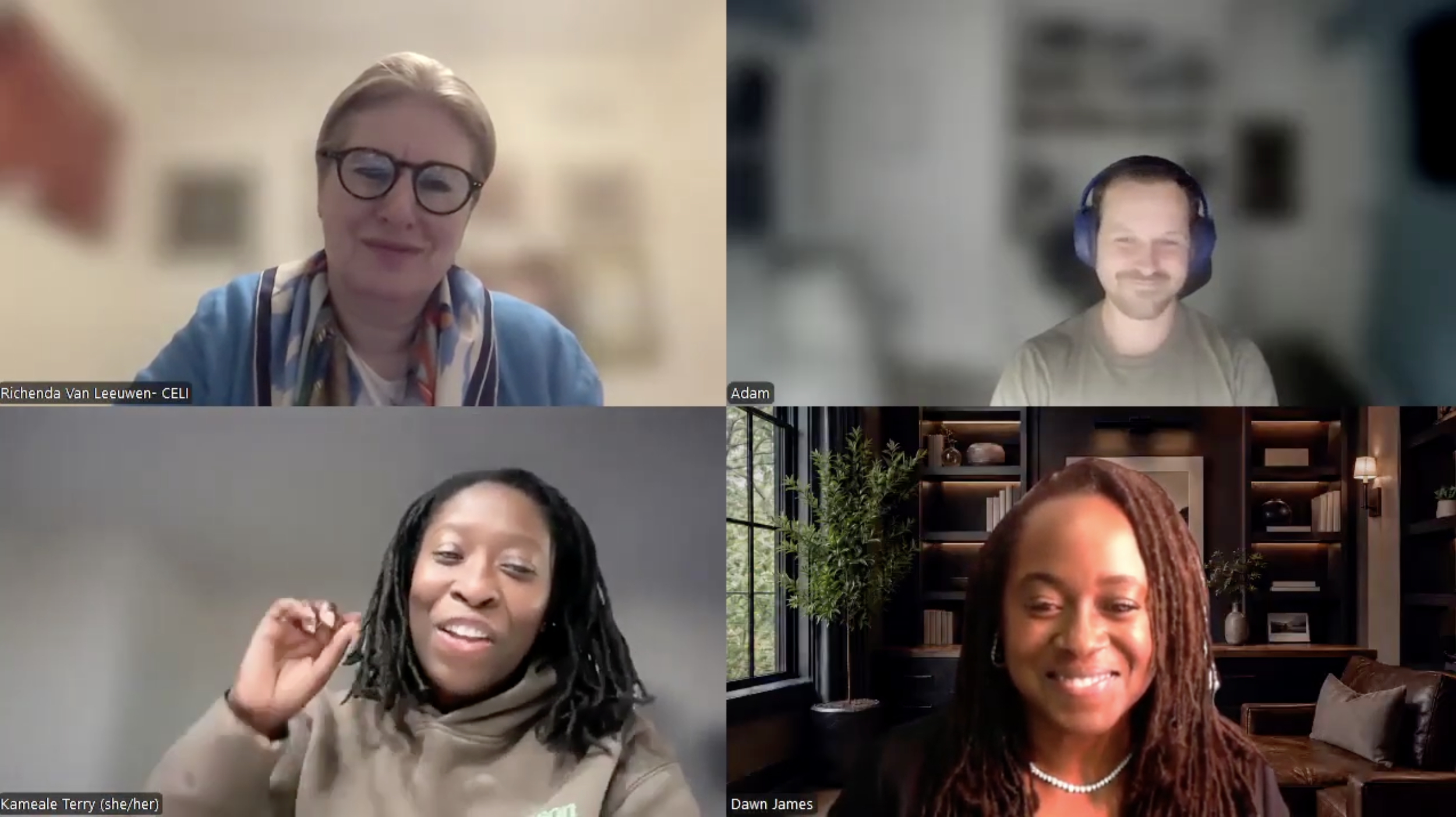
A philosophy major becomes an energy investor. A geoscientist moves into corporate strategy and electricity policy. A former banker builds an electric vehicle charging company. There is no single route to a career in clean energy, and perhaps that's the point. During CELI's recent Clean Energy Careers webinar, Executive Director Richenda Van Leeuwen joined board members Kameale Terry, Adam James, and Dawn James for a candid conversation about professional development, setbacks, and the decisions that have shaped their careers. Their experiences were remarkably different, but a common lesson emerged: career growth often comes from being willing to abandon the original plan.
For Kameale Terry, co-founder and CEO of ChargerHelp, that lesson came through rejection. After several unsuccessful attempts to gain admission to business school, Terry took a position in driver support at EV Connect, an early-stage charging startup. The work was difficult, often involving frustrated customers, but the experience exposed her to a problem she would eventually build a business around. Nearly seven years into running ChargerHelp, Terry now sees those setbacks differently. Throughout her career, from nonprofit work to banking and entrepreneurship, her commitment to economic mobility has remained constant, even as her approach has changed. Her advice to emerging professionals is practical: maintain a record of your accomplishments, look for opportunities to demonstrate skills associated with your next desired position, and recognize that meaningful progress often involves discomfort.
Dawn James, executive director of the Texas Energy Buyers Alliance, has built a career on reinvention. Trained as a geoscientist, she worked in geotechnical engineering and hydrogeology before moving into energy, technology strategy at Microsoft, consulting, and eventually electricity policy. One early opportunity came when she volunteered to lead geology hikes on Catalina Island. A U.S. Geological Survey scientist happened to attend, and the connection led to a job. For James, the experience illustrates the value of creating opportunities rather than waiting for them. She approaches professional setbacks with a similar outlook, describing rejection as redirection. Her advice centers on courage: be willing to work outside your comfort zone, particularly when the next step requires skills you have yet to develop.
Adam James, CELI co-founder, Board Chair, and partner at Energy Impact Partners, offered a different measure for professional success. After studying philosophy at George Mason University, he began his clean energy career in public policy before moving through market research, the private sector, and investment. His career has required repeatedly learning new skills, but he believes the ability to understand and support other people's work has been more enduring than any particular technical expertise. At each turning point, James asks himself, "Where can I be uniquely useful?" He also spoke openly about the difficulty of defining success through an endless series of professional achievements. Learning to recognize personal limits, decline commitments, and make time for family has become an important part of his development as a leader.
For Richenda Van Leeuwen, whose own career post-college started with helping people recover from addiction, and humanitarian work in Hong Kong before moving into emerging markets and years in renewable energy venture capital and policy before leading CELI, the conversation reinforced the value of transferable skills. She recalled hiring a grants manager partly because of her college bartending experience, recognizing that dealing with difficult customers could translate into professional effectiveness. Van Leeuwen also shared how acting training helped her overcome an early fear of public speaking.
These examples point to a larger lesson from the discussion: experience does not need to fit neatly into a job description to be valuable. In an industry facing technological change and constantly shifting market conditions, the ability to adapt may matter as much as the expertise professionals already possess. And as each panelist made clear, relationships are often what make those transitions possible. For CELI Fellows and alumni, that is a compelling reason to invest in building relationships in the community around them, even when the next career move is not yet apparent.